162,000 Jobs in August: What the Left Sees, What the Right Sees, and What the Numbers Say
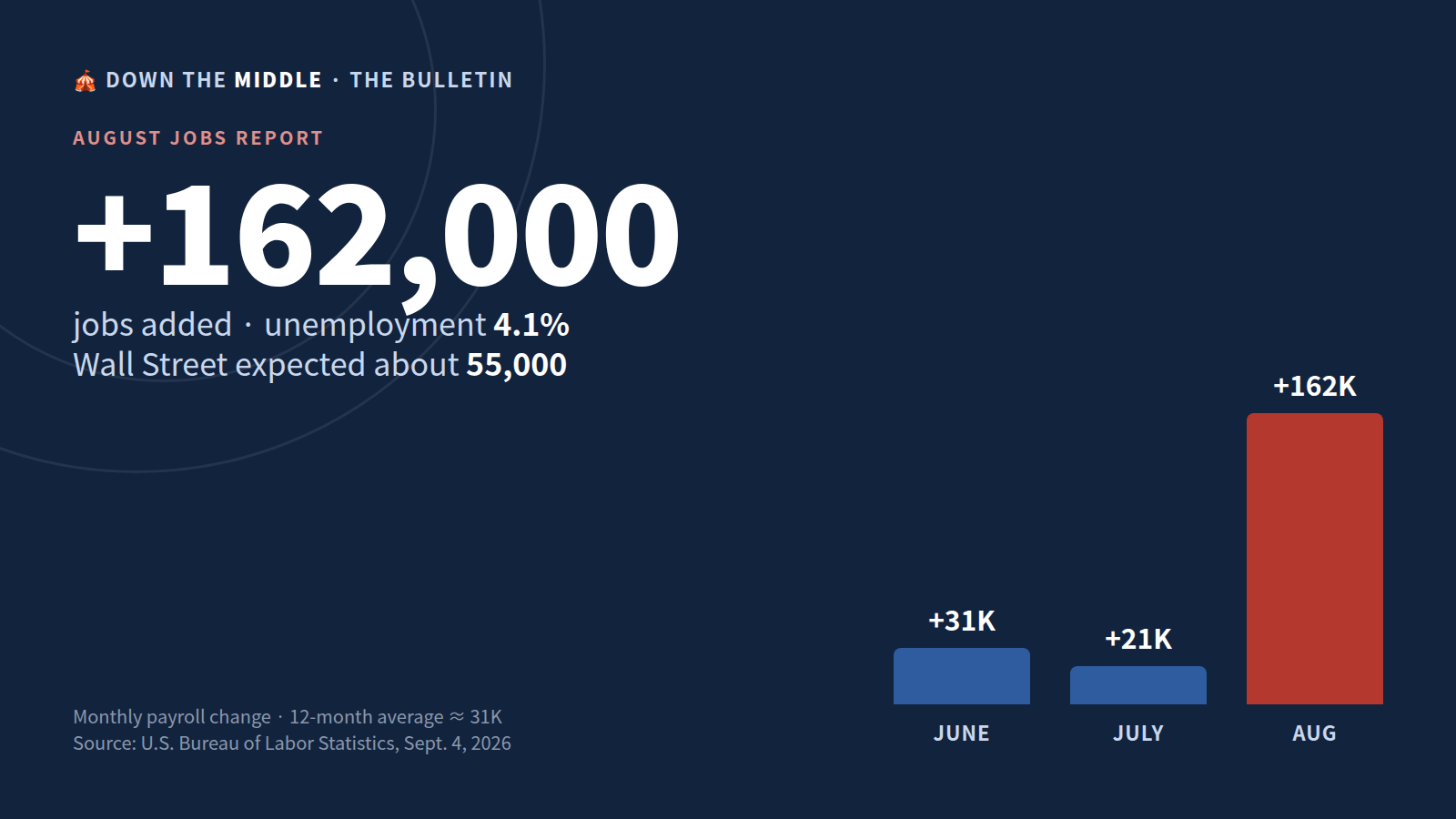
Friday morning's jobs report landed like a plot twist. Economists expected the U.S. to add somewhere around 55,000 jobs in August. The Bureau of Labor Statistics said the real number was 162,000 — roughly three times the forecast and the strongest month since spring. Unemployment held at 4.1%.
Within an hour, the same report was being described as proof the economy is roaring and proof that working people are still falling behind. Both descriptions cite real numbers. That's what makes this one worth reading down the middle.
First, what the report actually says
- Payrolls: +162,000 in August. June was revised up to +31,000 and July to +21,000 — a combined 55,000 more jobs than first reported.
- Unemployment: 4.1%, unchanged. Labor-force participation ticked up to 61.6%.
- Where the jobs came from: restaurants and bars (+59,000), local public schools (+42,000), construction (+22,000), manufacturing (+16,000), health care (+13,000).
- Where they went: the information sector — publishing, broadcasting, computing infrastructure — lost 23,000.
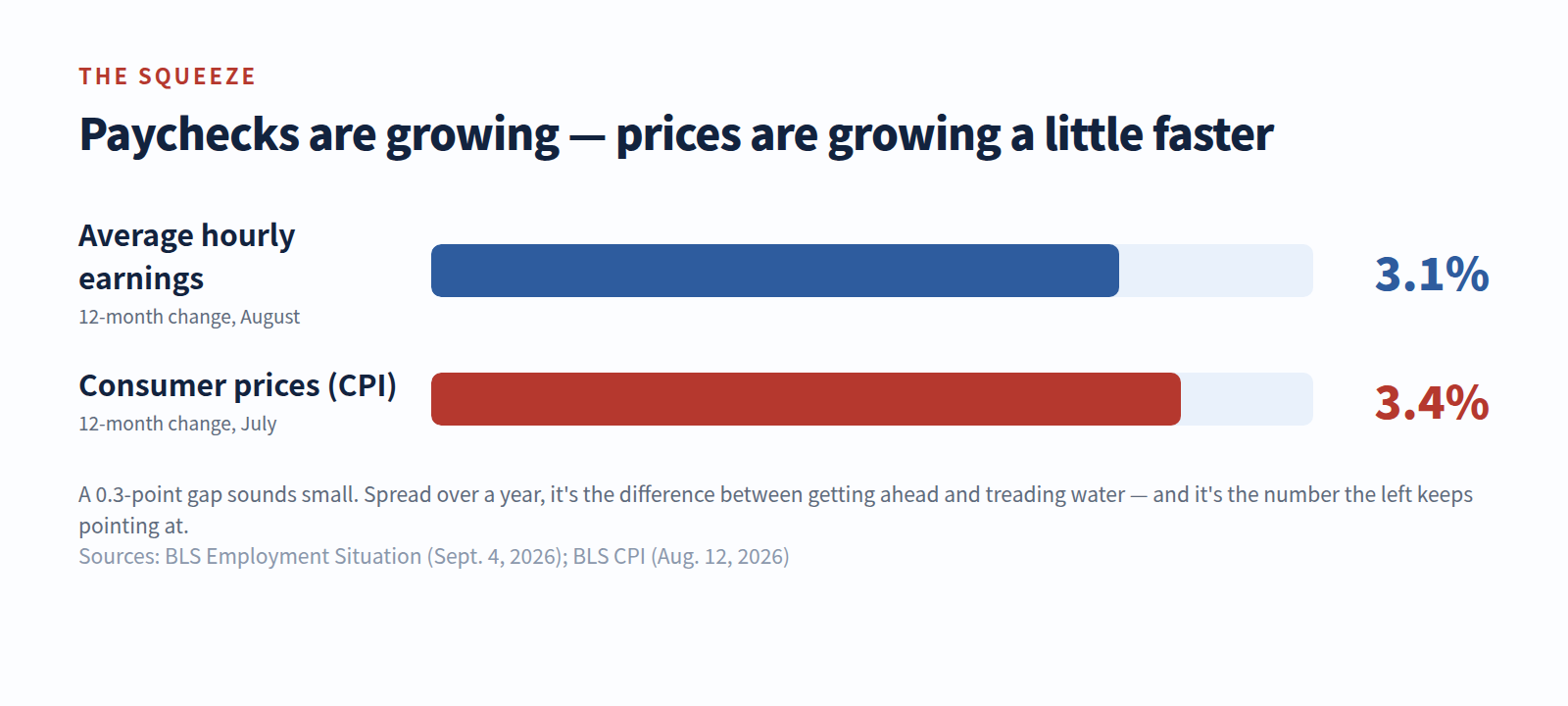
- Wages: average hourly earnings rose 0.3% for the month and 3.1% over the past year. Consumer prices, per the most recent CPI, are up 3.4% over the same span.
From the Left: One Good Month Doesn't Erase a Bad Year
Progressive and Democratic voices led with the wage line. Rep. Bobby Scott put it plainly: inflation is still outpacing paychecks. At 3.1% wage growth against 3.4% inflation, the typical worker's raise is being eaten before it hits the checking account.
The second argument is about the trend, not the month. Even with August's surge, job growth over the past twelve months has averaged only about 31,000 a month — a fraction of the pace of a few years ago. A single strong print, the argument goes, doesn't undo a year of stalling.
Third, look at the mix. The biggest gains were in restaurants and local schools; the losses were in information and tech-adjacent work. Critics read that as a labor market adding lower-wage service jobs while higher-paying sectors shrink — and they note that a Fed rate hike, now more likely, would land first on families carrying credit-card and mortgage debt.
From the Right: The "Stalling Economy" Story Just Collapsed
Conservative outlets and the White House led with the headline number and the revisions. For months, the argument goes, Democrats built a midterm message around a slowing labor market. August blew a hole in it: 162,000 jobs, two prior months revised up, participation rising, and gains in exactly the sectors the administration promised — construction and manufacturing.
National Economic Council Director Kevin Hassett credited tariffs with pushing companies to "onshore activity," and pointed to full expensing of investment as the driver behind construction hiring. In this telling, the policy mix is working and the data finally shows it.
There is one place the right's message splits from the market's. President Trump responded to the report by again calling on the Fed to lower rates, arguing the U.S. is "a much stronger credit." Futures traders went the other direction: the odds of a quarter-point hike at the Fed's mid-September meeting jumped from 49% to about 60% on the news.
Down the Middle: Both Sides Are Right About Part of It
Here's the honest read.
The strong month is real. You don't get 162,000 jobs, upward revisions and rising participation from a labor market that's falling apart. The right is correct that the "stalling" narrative needs an update.
The weak year is also real. Twelve-month average job growth around 31,000 is thin, and wages trailing prices by three-tenths of a point is a genuine squeeze. The left is correct that one report doesn't make a recovery.
And the thing that actually matters next isn't in this report. Morgan Stanley's Ellen Zentner said it best: the strong payroll number "will likely ramp up concerns about a rate hike, but that outcome is in the hands of next week's inflation numbers." A Fed that hikes in an election year will do it because of prices, not because of jobs. Watch the CPI release, not the cable-news scoreboard.
The question worth sitting with
If the Fed does raise rates this month to cool inflation, and that slows hiring, which side will claim vindication — and will either of them be right?
Sources: U.S. Bureau of Labor Statistics, Employment Situation (Sept. 4, 2026) and Consumer Price Index (Aug. 12, 2026); CNBC; NBC News; Fox Business; Kiplinger; CME FedWatch.